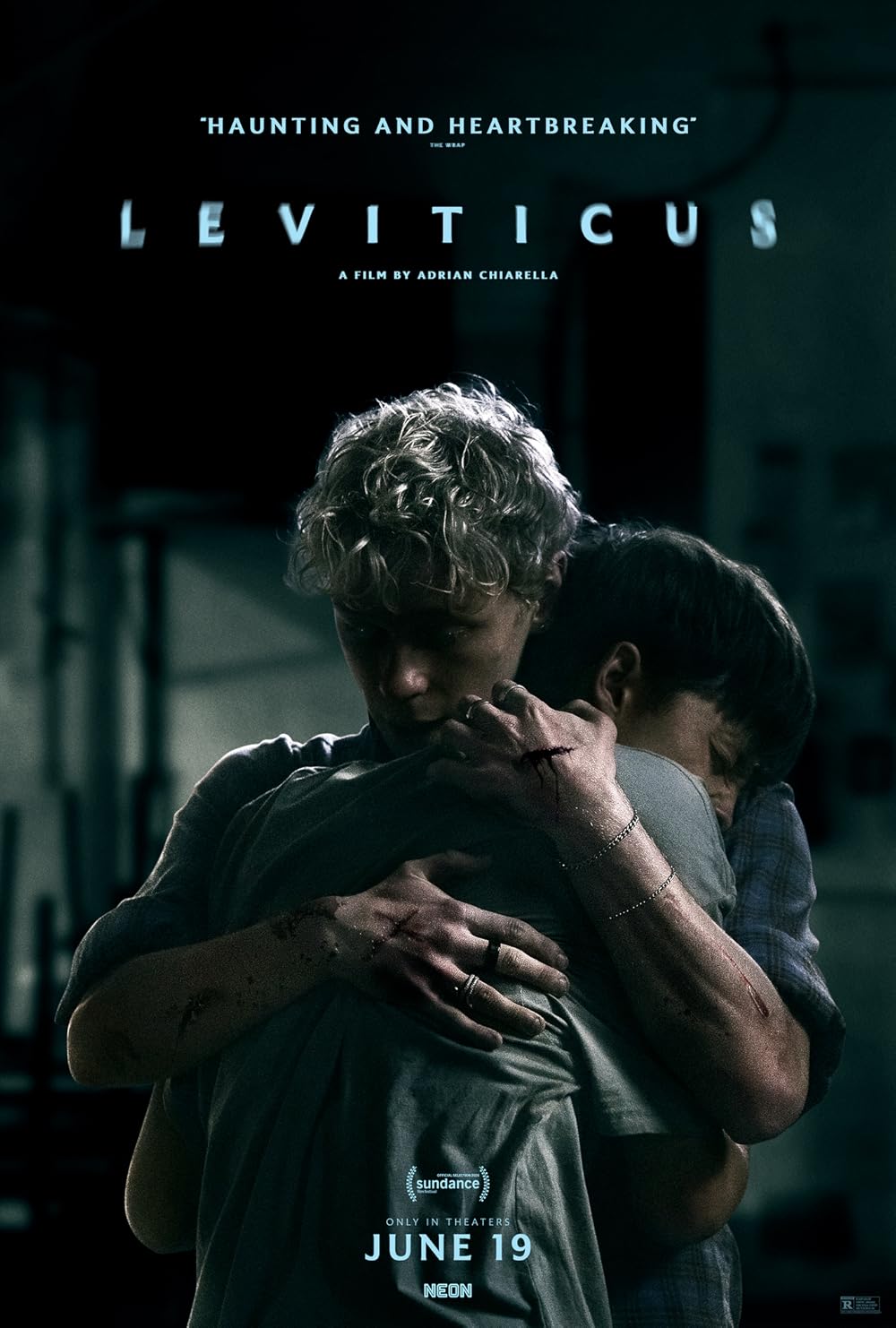
Leviticus
9OUT OF 10Exceptional
“The real horror is not love, but what people are willing to do when they decide that love must be punished.”
“The real horror is not love, but what people are willing to do when they decide that love must be punished.”
Leviticus is beautiful in a way that never allows you to feel safe. The cinematography is one of the film’s greatest strengths. While watching, I suspected that it had been shot with anamorphic lenses, and that visual character can be felt in almost every frame. The stretched highlights, soft edges, shallow focus, and slight distortion give the film an intimacy that feels romantic and unsettling at the same time. I love anamorphic photography, and Leviticus uses it incredibly well.
The colors, lighting, atmosphere, and sound all seem to belong to the same emotional world. There is a softness to the quieter scenes between Naim and Ryan, but it is never completely comforting. Even the warmest images seem to contain the possibility of something terrible waiting just outside the frame. That tension is where the horror begins.
At its center, Leviticus is a love story about Naim and Ryan, two boys living in a deeply religious community where their feelings are treated as something shameful that must be corrected. A ritual intended to make them “normal” instead leaves them cursed. Whenever either of them is alone, an entity appears wearing the face of the person he desires most. The idea is simple, but emotionally brutal. The face that represents love, comfort, and safety becomes the face of something trying to kill you. I think that concept is brilliant. I cannot remember seeing anything quite like it. The curse turns intimacy into terror, not because there is anything dangerous about Naim and Ryan’s relationship, but because the people around them have forced fear, shame, and violence into it.
The film also understands how repression changes the way affection is expressed. Before their first kiss, Ryan and Naim roughhouse and throw objects at each other, not because they genuinely want to cause harm, but because aggression gives them a socially acceptable disguise for attraction. The film repeats this behavior later, making it clear that violence has become a language these boys use because tenderness feels too dangerous. There is something deeply sad about that. Tenderness is forbidden while aggression is normal, so even intimacy has to pass through pain before it can become visible. Love and punishment have become intertwined in the way these boys understand themselves.
The film makes that rejection especially painful through Naim’s mother. She forces the Deliverance Healer upon her son because she believes that something inside him needs to be removed or corrected. Then, after the ritual causes something genuinely horrifying to happen, she refuses to believe him when he tries to explain what he is experiencing. That was one of the most frustrating parts of the film for me. She is willing to believe that her son is spiritually corrupted, but unwilling to believe him when he says that he is suffering. She trusts the healer and the belief system that harmed him more than she trusts her own child. A mother should be a source of safety and unconditional love. Instead, she becomes part of the reason Naim is unsafe. The film shows how rejection can disguise itself as concern. She may believe she is saving him, and she may genuinely think that the healer is helping, but good intentions do not erase the harm she causes. Her refusal to accept Naim allows her to participate in something cruel while continuing to see herself as a loving mother. That contradiction feels painfully real. People can claim to love someone while rejecting a central part of who they are. They can call that rejection protection, faith, morality, or concern, but to the person being rejected, it still feels like abandonment. The ritual becomes a physical expression of that abandonment. The adults believe they are removing something unnatural from the boys, but they are actually introducing the horror into their lives. Naim and Ryan are not dangerous before the ritual. Their feelings do not create the monster. The attempt to destroy those feelings does.
The horror scenes are genuinely frightening because the film never treats the entity as just another creature. The lighting and sound design make familiar spaces feel unsafe, often holding on darkness just long enough for you to begin searching the frame yourself. Because the entity takes the form of Naim or Ryan, every encounter is emotionally confused. The characters are confronted by the face they most want to trust, and the creature uses affection as camouflage.
Joe Bird and Stacy Clausen make that contradiction work. Both performances are excellent, especially in the quieter scenes. Their connection feels awkward, tender, and young. They do not feel like characters created only to represent an idea. They feel like two people trying to understand each other while everyone around them insists that what they feel is wrong.
The entity becomes stronger whenever they grow closer, as though the curse is trying to teach them that intimacy will always lead to punishment. Every step toward one another increases the danger. What I appreciated most is that the film never accepts separation as the solution.
The ending works because the curse is established as permanent, and the film does not undermine that by inventing a convenient reversal. There is no forgotten ritual, hidden weakness, or easy cure. What was done to Naim and Ryan cannot simply be erased, and I respect the film for committing to that. Rather than defeating the curse, the boys choose to build a life around the damage done to them. Their solution allows them to remain together, but it also forces them to leave behind their homes, their families, and the possibility of ever feeling completely safe. That makes the ending hopeful without pretending that everything has been repaired. The people who tried to separate them still fail. The ritual changes their lives permanently, but it does not convince them that their love is something they should abandon. The curse tries to make closeness terrifying, and their answer is to remain close anyway.
Leviticus does not suggest that every wound can be healed or every form of trauma reversed. Sometimes people permanently change your life through their cruelty. Sometimes there is no return to the person you were before. The question then becomes whether that damage gets to decide what happens next. Naim and Ryan cannot remove the monster, but they refuse to let it separate them.
Leviticus is visually beautiful, genuinely frightening, and built around a concept that turns emotional repression into something physically monstrous. More than anything, it understands that the real horror is not love, but what people are willing to do when they decide that love must be punished.
It is easily one of the strongest LGBTQ films of the year, not simply because of what it represents, but because of how powerfully it turns that experience into cinema.