Obsession
8OUT OF 10Great
“He was so afraid of rejection that he made love impossible.”
“He was so afraid of rejection that he made love impossible.”
I have watched Obsession twice now. The first time was with one friend. The second time was with a much larger group. And somehow, even when surrounded by people, the film still managed to make the room feel deeply uncomfortable.
I rarely watch horror movies, but I am not even sure Obsession is frightening in the traditional sense. It does not rely on constantly making you jump or hiding something in the corner of the frame. Instead, it traps you inside a feeling. From the moment the story begins, something feels wrong, and that feeling never leaves. It grows, mutates and becomes more suffocating until discomfort itself becomes the horror.
That is what the film does better than almost anything else. It does not simply show you obsession. It makes you feel what it would be like to live inside it.
What makes that even more impressive is that Curry Barker and his team reportedly made the film for approximately $750,000. It does not look like a film made for that amount of money. The concept is ambitious, the filmmaking is controlled, and nearly every creative choice feels deliberate. Considering how successful it became, the entire achievement is honestly astonishing.
A huge part of why it works is Inde Navarrette.
Her performance as Nikki is phenomenal. She can feel loving, threatening, desperate and completely broken within the same scene, sometimes without changing much more than her expression. There are moments when she appears almost childlike in her dependence on Bear, followed by moments in which she becomes genuinely terrifying. Yet none of those versions feel disconnected from one another. They all feel like different stages of the same person being destroyed by a wish.
The rest of the cast is also excellent, especially considering that many of them were relatively unknown. Nothing about the performances feels amateurish or uncertain. Everyone commits fully to the film’s strange emotional reality, which is essential because the concept could have become ridiculous very easily. Instead, they make it disturbing.
The cinematography understands that disturbance perfectly.
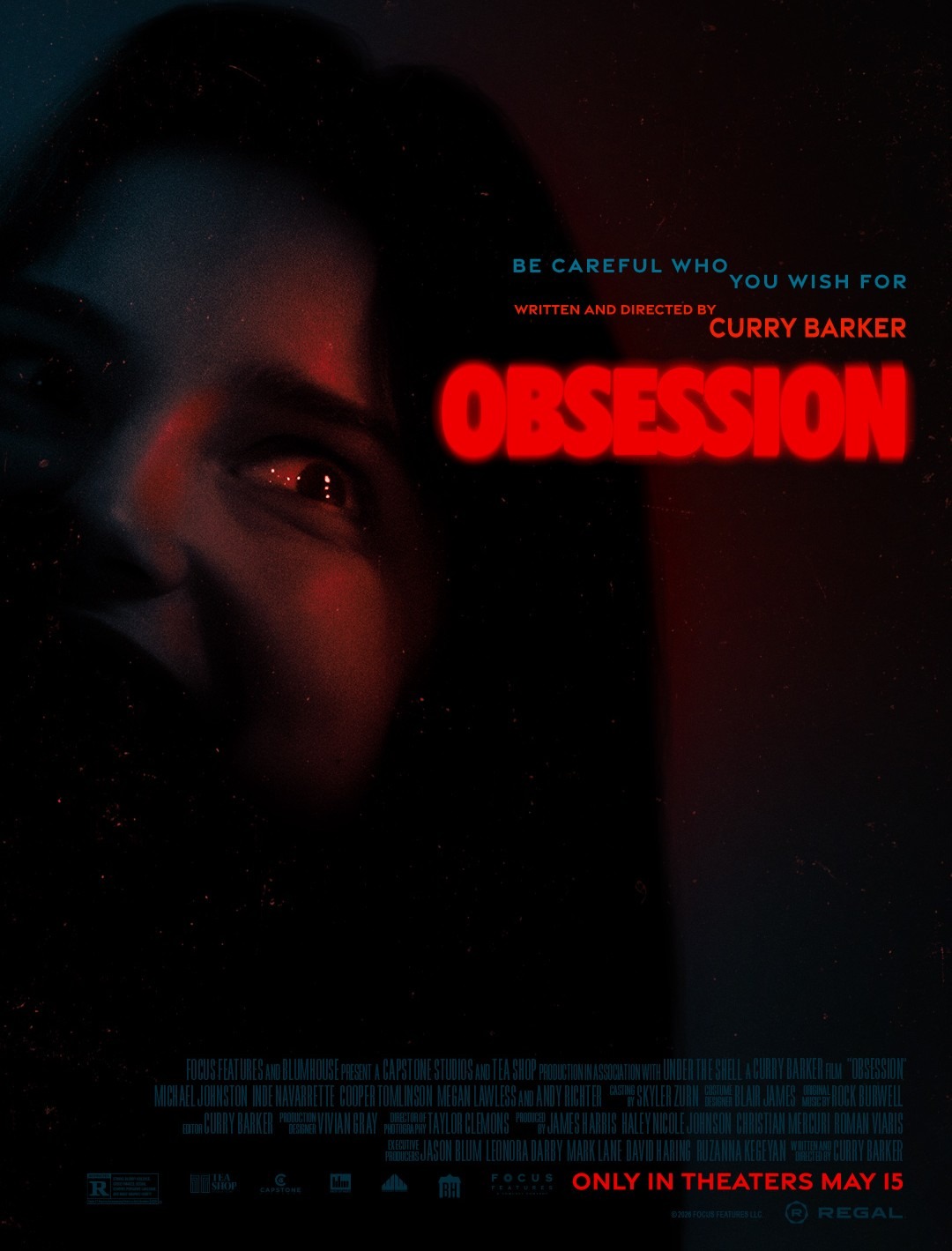
My favourite image in the entire film is Nikki standing in Bear’s doorway wearing a red dress. She is almost completely swallowed by shadow. You cannot properly see her face, but two tiny white reflections remain visible in her eyes. The image lasts only a moment, yet it tells you everything. Nikki is still physically there, but something about her is no longer human.
The sound design does the same thing in a less visible way. It constantly presses against you, creating unease even when nothing overtly horrifying is happening. The film rarely allows you to relax. Every sound, silence and visual composition seems designed to keep you slightly off balance.
Even the unusual 3:2 aspect ratio contributes to that feeling. The frame is boxier than what you usually see in modern films, giving the images an almost photographic quality. Train Dreams used a similar ratio to create intimacy and nostalgia. Obsession uses it like a cage. The characters do not merely exist inside the frame. They appear trapped by it.
The entire story is trapped inside a circle as well.
It begins with a death caused by drugs. It ends with another death caused by drugs. Between those two moments, Bear’s wish leaves behind a trail of more death, suffering and destruction. The film ends in almost the same place where it began, as though the consequences of his decision were always going to return to him.
And it is his decision.
Bear wishes for Nikki to love him more than anyone else in the fucking world, but not because the film clearly tells us that she does not already have feelings for him. We never really find out what Nikki would have chosen. I read Bear as someone who is simply too afraid to tell her how he feels, and too afraid to risk hearing an answer he cannot control.
He could confess. He could allow himself to be vulnerable. He could give Nikki the chance to respond honestly.
Instead, he skips the uncertainty entirely.
The wish does not guarantee that Nikki will choose him. It removes the need for her to choose at all. Bear uses magic to avoid the possibility of rejection, but in doing so, he also destroys the possibility that her love could ever be genuine.
That makes the wish even more tragic. Nikki may have loved him. She may not have. Bear will never know, because his fear prevents him from asking and his wish erases the answer before she can give it.
After the wish, Nikki does not simply fall in love with him. She becomes incapable of existing without him. When he leaves her alone to go to work, she becomes so distressed that she urinates on herself. She follows him, waits for him and treats his absence as though she is being deprived of oxygen.
In a sense, Nikki becomes his pet.
What looks like devotion is actually total dependence. Bear has not created love. He has taken a person and reduced her to a need. Nikki no longer chooses him because there is no longer a version of her capable of choosing anything else.
That is why Bear, not Nikki, is the real antagonist of Obsession.
Nikki commits the most horrifying acts, but Bear is responsible for creating the person who commits them. More importantly, once he understands what the wish has done, he repeatedly refuses to end it. Nikki begs him to kill her. She begs him to free her. He knows that the real Nikki is still trapped somewhere inside the obsession he created.
And he still cannot let her go.
His refusal is not compassion. It is selfishness disguised as mercy. Bear would rather keep a corrupted version of Nikki who worships him than release the real Nikki from her suffering. Even after witnessing the consequences of his wish, he remains attached to the fantasy it gave him.
Near the end, it finally appears that Bear may accept responsibility. He takes the drugs knowing that his death could release Nikki. For one moment, it seems as though he is prepared to sacrifice himself and complete some kind of redemption.
Then he changes his mind.
At the last possible second, Bear tries to make himself vomit. That single action destroys the redemption he almost earned. When death becomes real, his instinct is not to save Nikki. It is to save himself.
Nikki is the one who ultimately interrupts him.
She uses her own wish and wishes for Bear to love her. The wish pulls his attention back toward her and prevents him from continuing to vomit. His death is not necessarily what Nikki directly wishes for. It is a side effect. But it is also the side effect that finally releases her.
Bear begins the story by taking away Nikki’s free will because he is too frightened to face uncertainty. Nikki ends it by taking away Bear’s free will because it is the only way she can escape him.
There is something brutally fitting about that reversal.
Bear does not complete his sacrifice willingly. He does not truly redeem himself. Nikki has to force the ending he was too selfish to finish. The same supernatural power that imprisoned her becomes the thing that allows her to break free.
That is what makes Obsession so much more disturbing than a simple story about a woman becoming dangerously obsessed with a man. It is a story about someone who is so frightened of uncertainty that he replaces love with control.
Bear does not trust Nikki enough to let her choose him, and he does not trust himself enough to survive if she does not.
He does not want to risk rejection.
He wants to make it impossible.
And by removing that risk, he also removes everything that could have made her love real.