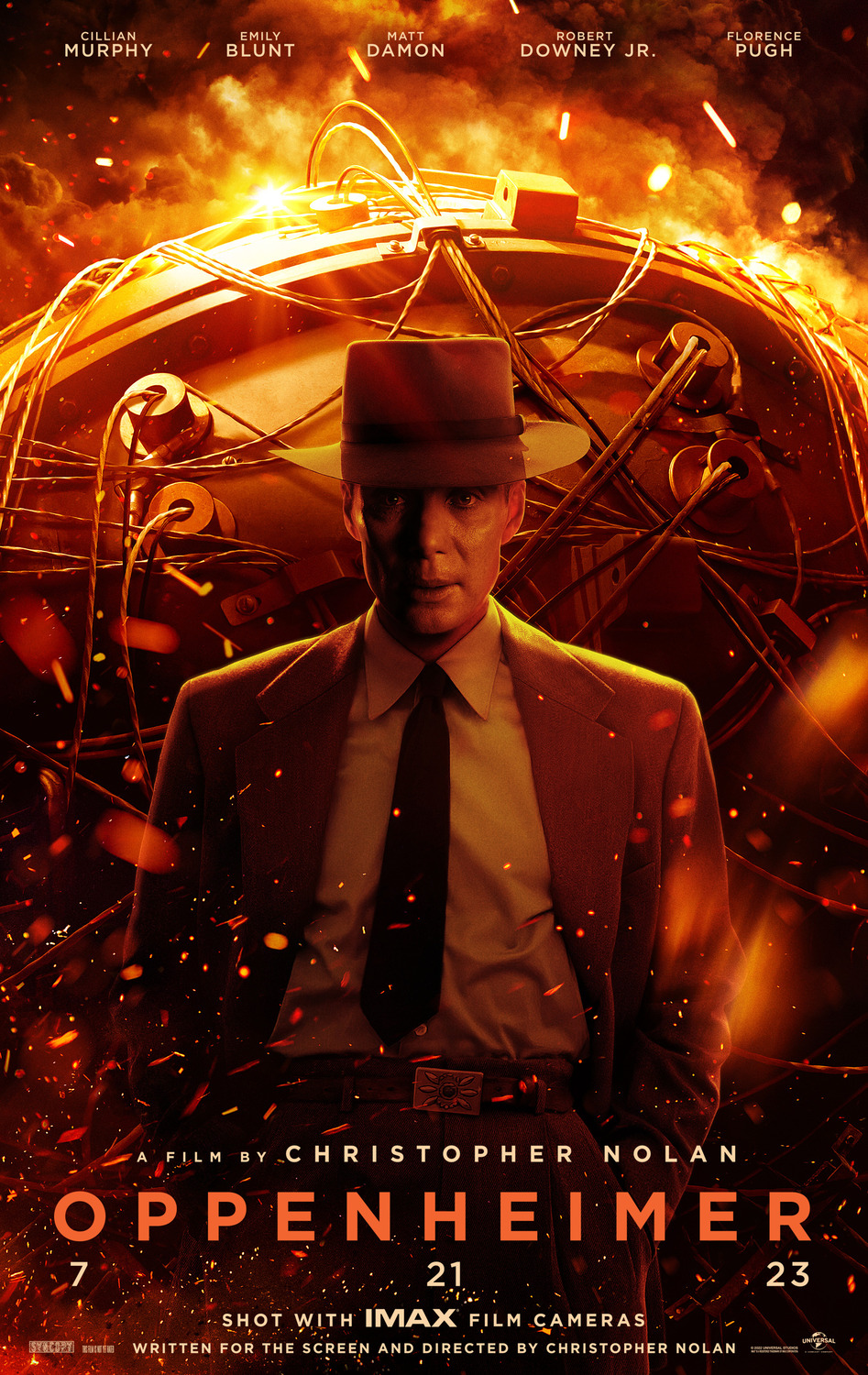
Oppenheimer
8OUT OF 10Great
“Humanity gained control over the atom, only to discover that control was the first thing it had lost.”
“Humanity gained control over the atom, only to discover that control was the first thing it had lost.”
Christopher Nolan has been my favorite director for a long time, so I was always going to be excited about Oppenheimer. His films usually feel like events, even before you know much about them, you expect something large, carefully made, and designed to be seen in a cinema rather than on a laptop. Oppenheimer is definitely all of those things, although not always in the way I expected.
Nolan and cinematographer Hoyte van Hoytema shot the film using IMAX 65mm and regular 65mm film, and when it's projected from an IMAX 70mm print the image is enormous. What surprised me is that this format isn't used only for explosions or wide landscapes, a lot of the film is just faces, offices, people sitting around tables. Somehow those things feel just as overwhelming as the Trinity test. The camera pays close attention to tiny changes in expression, especially in Cillian Murphy's face; a glance or a moment of hesitation can fill the entire screen. It's a strange but very effective use of such a large format, using one of the biggest filmmaking formats ever created to show a man thinking, worrying, and slowly realizing he's lost control of what he helped create. As someone who loves analog media, I obviously enjoyed that side of it.
Still, I can't ignore that Oppenheimer is very long, maybe even too long. At three hours it demands a lot from the viewer, introducing a huge number of scientists, politicians, military officers, institutions, and historical events. I'm not American and wasn't already familiar with all the political details, so there were moments I struggled to follow exactly what was happening. I could usually get the emotional point of a scene but not always the political one, I'd be unsure who had authority over whom, why a particular accusation was so serious, or how one hearing connected to another.
The structure doesn't help at first. The film moves between several periods of Oppenheimer's life, his early scientific career, the development of the bomb, his 1954 security hearing, and the later confirmation hearing involving Lewis Strauss, and these aren't shown in order. Nolan keeps cutting between them, often using one period to change how you understand another. Once I got the structure I found it rewarding; before that, it was just confusing. The visual differences help a lot, at least. Most of Oppenheimer's story is in color, while Strauss's sections are black and white, and that black-and-white footage looks incredible. I don't think black-and-white film has looked this sharp, dramatic, or honestly this sexy in a modern blockbuster.
Downey is excellent as Lewis Strauss. For years his career became almost completely associated with superhero films, and that success made him one of the most famous actors in the world but also made it easy to forget how subtle he can be in a dramatic role. Strauss was a perfect character for him, intelligent, charming, proud, insecure, deeply resentful. At first he seems controlled and reasonable. Over time it becomes clear how much of his behavior is driven by humiliation and wounded pride. It's a performance built from small reactions rather than speeches. Downey reveals the character slowly instead of announcing what Strauss is feeling.
Cillian Murphy is even better. His performance is the center of the film and might be the best work he's ever done. He doesn't just imitate the real person, he creates someone who always seems to be thinking about several things at once. Murphy makes Oppenheimer brilliant, ambitious, arrogant, guilty, and strangely fragile all at once. He wants recognition but seems uncomfortable with what that recognition represents. He understands the importance of his work and yet repeatedly fails to understand the personal and political consequences of his choices. As the film goes on his body seems to get thinner and more exhausted, his eyes often fixed on something no one else can see. Even when people are celebrating him he already looks haunted. That's one of the most effective things about the film, Oppenheimer gets what he wanted, and the achievement destroys his ability to feel proud of it.
Most films about an atomic bomb would save the explosion for the ending. The bomb goes off, the screen turns white or black, credits roll. Oppenheimer puts the Trinity test around the middle instead. Before it, the bomb is treated as an almost impossible scientific problem, can it even be built, will it work, could the test itself produce something nobody understands. The tension builds toward the explosion, and then it goes off. But the film keeps going, and that choice is more disturbing than ending on the blast would have been. Building the bomb isn't the conclusion of Oppenheimer's story, it's the point where the real consequences start. After the test the bomb stops being a scientific project and becomes something that belongs to governments, soldiers, political systems. Oppenheimer helped unlock a new force but doesn't get to decide what happens to it. He seems to believe that creating the weapon will give him some influence over its future use. Instead he learns the opposite is true, once the thing exists, his personal opinions matter a lot less than he thought.
The Trinity sequence itself is remarkable. Nolan avoided relying entirely on CGI, using practical explosions, chemical reactions, miniatures, and compositing to build the test and the abstract images that recur through the film. The effects don't always look like a scientifically accurate nuclear explosion, but that didn't bother me, they feel physical, with texture and imperfections that make them feel photographed rather than generated. Even the abstract shots of particles, fire, and collapsing matter feel connected to something real in front of the camera.
Ludwig Göransson's score is a huge part of the film's intensity too. The music rarely lets the audience relax, moving constantly with racing strings and rising rhythms under scientific discussions, political arguments, scenes that might otherwise feel quiet. In another film a lot of these would just be men talking in rooms; here they sometimes feel as tense as action sequences. The score does occasionally get loud enough to compete with the dialogue, there were moments I had trouble hearing what people were saying, but emotionally it works. It puts you inside Oppenheimer's restless mind, capturing both the excitement of discovery and the fear of realizing where it's leading.
I also felt an unusual sense of Hungarian pride watching this. Several Hungarian-born scientists, Edward Teller, Leó Szilárd, Eugene Wigner, played major roles in nuclear physics and around the Manhattan Project, and their contribution to twentieth-century science was enormous. Not a simple thing to feel proud of, though. Their work got tied to one of the darkest technological developments in history, and Teller later became closely associated with the hydrogen bomb, even more destructive than what came out of the Manhattan Project. Still, the film reminded me how much influence Hungarian scientists had on modern science. Impressive, and uncomfortable at the same time.
That tension is one of the main ideas running through the film. Scientific discovery gets presented as something pure, separate from politics and morality, but knowledge doesn't stay under the control of whoever discovers it. Once it exists, other people use it, develop it, weaponize it, turn it into something its creator never intended. Oppenheimer seems to believe his scientific importance will protect him and give him influence. For a while the government celebrates him because he's useful. Later, when his moral objections become inconvenient, the same system turns on him. The security hearing is especially frustrating because it feels less like an honest investigation and more like a process built to humiliate him and take away his influence. He helps build the weapon and then finds out the weapon, and everything around it, no longer belongs to him.
To me the film isn't just arguing that scientific progress can be dangerous. It's about how creators overestimate how much control they'll have over what they create. Oppenheimer helps release something too large for any individual to control, and almost immediately it becomes part of political systems shaped by rivalry, fear, ambition, self-interest.
It also raises uncomfortable questions about deterrence. Nuclear weapons may have helped prevent direct war between major powers during parts of the Cold War, the possibility of mutual destruction created a kind of stability. But it's a disturbing kind of stability. The danger didn't disappear, it just got so large that everyone was afraid to act. We've spent decades living with the possibility that a mistake, an escalation, or one person with enough authority could cause something irreversible. Nolan's line that we live in Oppenheimer's world feels right, the bomb doesn't end the film because the bomb didn't end anything. It started a new period of history, one where humanity became powerful enough to destroy itself and had to just trust that fear would keep it from doing so.
Oppenheimer isn't an easy film. It's exhausting in places, and the density of the story sometimes makes it feel even longer than three hours. If you don't already know the historical background, you'll probably have trouble keeping the names, hearings, and timelines straight. I certainly did. But even when I was confused I was never bored by the filmmaking itself. The performances, cinematography, editing, sound, music, and practical effects are all working at an extremely high level, and when it clicks, it feels monumental. Scientific discussions become suspenseful, ordinary conversations feel dangerous, and the development of the atomic bomb comes across not as a moment of triumph or horror but as the start of a problem we still haven't solved.