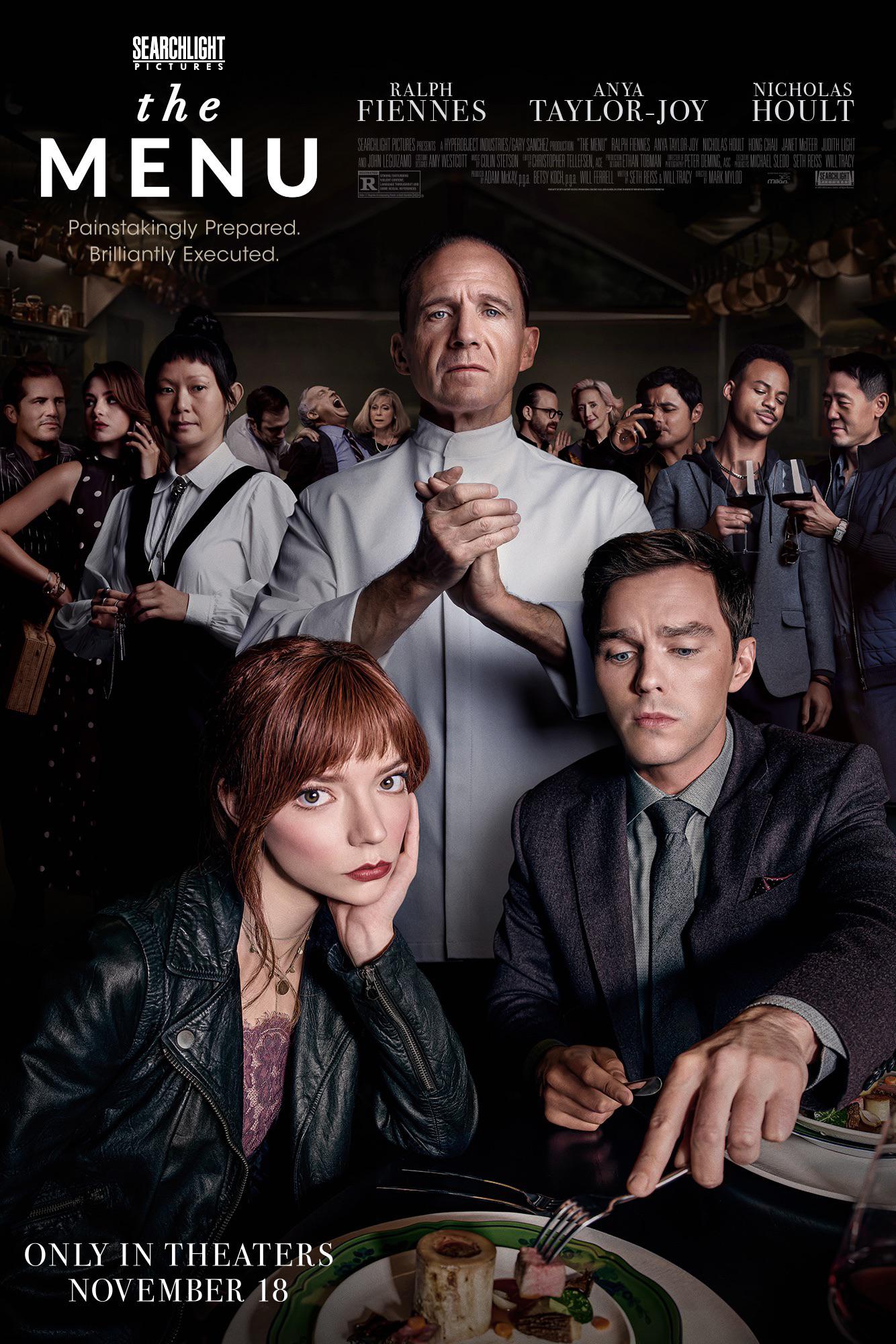
The Menu
8OUT OF 10Great
“A beautifully crafted descent into the dark side of art, obsession, and consumption. ”
“A beautifully crafted descent into the dark side of art, obsession, and consumption. ”
The Menu is one of the most satisfying movies I have seen when it comes to turning a simple premise into something much bigger. It is funny, dramatic, deeply unsettling, and, somehow, incredibly elegant while becoming more and more horrifying. What I loved most is that underneath all of the violence and absurdity, the movie is actually a very bitter story about art, consumption, entitlement, and losing sight of why you create something in the first place.
Ralph Fiennes is incredible as Chef Slowik. What makes the character work so well is that he does not feel like someone who simply hates rich people. He feels like someone who has become completely disgusted with what his work has turned into. Cooking was supposed to be an act of love, but Slowik has become trapped in an industry where everything has to be exceptional, exclusive, intellectual, and worthy of being consumed. Eventually, even he no longer seems to remember what made him love cooking. That is where I think the movie becomes much more interesting than a straightforward satire of wealth. Slowik does not just despise his customers. He despises the relationship between himself and his customers. They consume his work, judge it, photograph it, discuss it, assign value to it, and use it to elevate themselves. At the same time, he has participated in creating that world. He became exactly the kind of person he now hates.
The restaurant almost feels like a cult because of how completely everyone has surrendered themselves to the same philosophy. The synchronized movements, the obedience, and the ritualistic way everything is presented make the kitchen feel less like a workplace and more like a religious institution. That is what makes the mass suicide so disturbing to me. It is not simply shocking because people die. It is shocking because everyone accepts it as the natural conclusion of what they have built together. They have given so much of themselves to this idea of perfection that even death has become another part of the performance. At that point, the restaurant stops feeling like a restaurant at all. It becomes a place where people have surrendered their identities in exchange for belonging to something that they believe is greater than themselves.
The cinematography by Peter Deming makes every dish look almost impossibly precise. The restaurant is photographed with such control that it sometimes feels more like an art gallery than a place where people are supposed to eat. The symmetry, the overhead shots, the carefully arranged tables, and the sterile lighting all reinforce the idea that everything has been turned into an object to be examined and judged.
The score by Colin Stetson adds another layer to that feeling. It gradually becomes more anxious and oppressive, almost as if the music itself is tightening around the characters.
Anya Taylor-Joy's Margot is the perfect counterpoint to all of this. She is interesting because she is not impressed by the performance. She does not care about appearing sophisticated enough to appreciate Slowik. She is interested in whether the experience actually means anything to her. That is why the cheeseburger scene is so important. After all the elaborate courses, the endless explanations, and the obsession with artistic perfection, the most meaningful food in the entire movie is the simplest possible thing. A cheeseburger does not require a speech. It does not need to be exclusive. It does not need a critic to explain why it matters. It just needs to be good. And Slowik enjoys making it. For the first time, he seems to remember why he became a chef. That is why the cheeseburger feels almost more important than the entire rest of the menu. It represents pleasure without pretension. Food without status. Art without the need to prove that it is art. Margot does not ask Slowik to impress her. She asks him to cook something he can actually enjoy making. And he does. That moment also makes the title itself more interesting. The menu is not only the food being served. It is an argument. Every course is Slowik explaining what he thinks is wrong with his customers, his profession, and himself. By the end, the restaurant has become a perfect representation of what happens when art becomes more concerned with being admired than with making anyone feel anything.
That is also why Tyler is such a great character. He understands everything intellectually but almost nothing emotionally. He knows the terminology, the techniques, and the history. He can recognize what makes Slowik's food technically impressive. But he has forgotten the most basic reason anyone eats in the first place: because food should bring some kind of pleasure. He has turned appreciation into consumption. And I think that is the film's larger criticism. We do this with art all the time. We dissect it, rank it, criticize it, collect it, post about it, and use it to signal intelligence or status. At some point, we can become so focused on understanding whether something is important that we forget to ask whether it actually makes us feel anything. Slowik has fallen into exactly that trap. He has created something so obsessed with importance that it has stopped being enjoyable.
The movie is also incredibly funny in a way that makes the darker moments even more effective. The seriousness with which everyone treats the insanity of the evening is part of the joke, but it is also part of the horror. Nobody breaks character. Nobody stops performing. Everything continues according to the rules of the restaurant even when the entire evening has become completely deranged. And that is why the movie feels so controlled. Nothing feels accidental. The clapping, the rituals, the courses, the performances, the music, the cinematography, the guests, even the cheeseburger all serve the same larger idea. The Menu is ultimately about what happens when something you love becomes a machine. Slowik loved cooking. His staff loved cooking. But somewhere along the way, the industry, the customers, the critics, and their own obsession with perfection turned that love into resentment. The movie's tragedy is that Slowik wants to destroy the world that ruined cooking for him, but he has also become completely consumed by that world himself.
The ending therefore feels less like a victory and more like a final release.
The cheeseburger reminds him that there was once a reason to cook. For one brief moment, he is not a genius, not a celebrity chef, not an artist making a statement. He is just someone making food for another person. And that is enough.
The Menu is one of those rare movies where the satire, the suspense, the comedy, the performances, the cinematography, the music, and the horror all feel like they are working toward exactly the same idea. It is funny without weakening the drama, disturbing without becoming empty shock value, and pretentious while simultaneously making fun of pretension.